※Editor’s Note
In the era of the Fourth Industrial Revolution, calls for ‘science and technology innovation’ are growing louder. Among them are discussions about developing science and technology capable of solving the everyday problems citizens face. Through a series of expert contributions, Donga Science will introduce the concept of ‘social problem-solving science and technology,’ a topic actively being discussed in universities, government-funded research institutes, and the international science community, along with policy proposals for its governance, in four installments.

Proposing a Governance Model for Social Problem-Solving Science and Technology ④The Governance Proposal
By Song Woon-jin, Senior Research Fellow, Science and Technology Policy Institute (STEPI)
“We should now be talking about ‘the best science for the world’ rather than ‘the best science in the world.’”
Morten Østergaard, then Danish Minister for Higher Education and Science, delivered this speech at the opening ceremony of the ‘Science in Dialogue’ conference in Odense, Denmark, on April 23, 2012. He meant that it was time to shift from competing for ‘the best science in the world,’ centered on cutting-edge science and technology, to contemplating ‘the best science for the world,’ centered on the benefits for global citizens. It is still widely remembered as a landmark speech that changed the paradigm of science and technology.
●The Winds of ‘Science for Society’ Begin to Blow in Korea
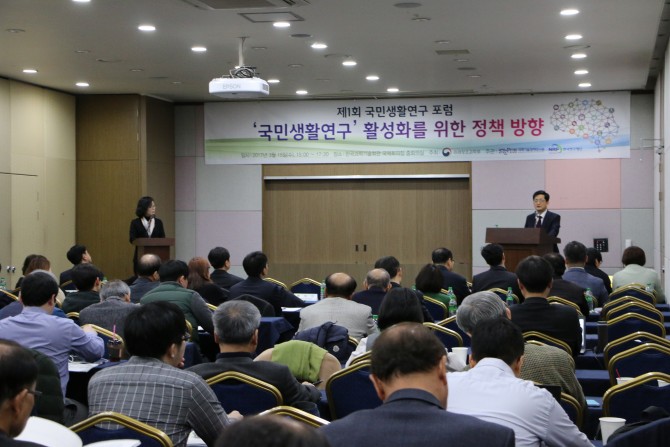
On March 15, the ‘National Life Research Forum’ was held at the Korea Science and Technology Center. It was a venue to explore science and technology that solves public life problems related to safety, welfare, and the environment, and takes root in the world of everyday life. Coincidentally, the results of the ‘Comprehensive Index of National Quality of Life’ survey, which showed that the quality of life has not improved much despite economic growth over the past decade, were released on the same day.
The forum was a success. It drew such a large crowd that informational booklets ran out, and the discussion went well over its scheduled time. Even with numerous agendas emerging ahead of the presidential election, it attracted the attention of the general public and the media. I participated as a presenter.
Although it used the somewhat retro-sounding term ‘National Life Research,’ the forum's content was future-oriented and innovative. First, it declared the importance of science and technology for civil society, moving beyond science and technology for the scientific community or for industry. It viewed science and technology through the eyes of the citizens, who supply the money and people for scientific activities and are their ultimate users.
Furthermore, by looking at science and technology through a new frame, it is calling for citizens, who have traditionally been objects of scientific activities, to become subjects. It emphasizes the participation of civil society in the process of identifying problems to be solved through national life research, setting research directions, and demonstrating developed products and services. As a mechanism for this, it focused on the ‘Living Lab.’
A Living Lab is an innovation model where citizens residing in a specific area or space participate in the co-evolution of products and services. For example, a school for the disabled or a local medical social cooperative providing care services would participate in a Living Lab to work with researchers to shape technologies that help solve their specific problems.
The ‘National Life Research Team,’ newly created within the Ministry of Science, ICT and Future Planning in January, also garnered interest. As the team leader, who participated as a panelist, stated, the establishment of a new team shows the ministry's will to prioritize this agenda in the future. The team, now staffed with 4-5 members, is expected to pioneer this new area, a significant expansion from when the task was handled by a single official.
●Many Hurdles Lie Ahead
However, the path for the National Life Research project—which aims to realize socially responsible science and technology with a new perspective, system, and organization—appears to be fraught with challenges. First is the inertia of the existing system. Until now, South Korea’s science and technology policy, the activities of universities and research institutes, and the media's perception of science and technology have all followed an ‘economy-first’ paradigm. This has been the guiding principle for government investment and policy decisions in science and technology, and the actions of various institutions and industry-academia-research entities are based on this framework.
Some researchers argue they are too busy writing papers and filing for patents to solve social problems. Others question why they should conduct research with low royalty returns. Public officials tend to believe that economic development will solve many problems. The media portrays the nation's future as dependent on responding to the Fourth Industrial Revolution and winning a Nobel Prize. Persuading these groups and revitalizing national life research focused on solving social problems will not be an easy task.
Creating a collaborative ecosystem for national life research also seems difficult. Not many researchers at universities or government-funded research institutes are interested in solving social problems. This is because the research funding is not large, and the evaluation system, which prioritizes papers, patents, and royalties, is not favorable to social problem-solving research. Social ventures, social economy organizations, and non-profit organizations interested in solving social problems are not yet well-established. They also have weak links to the science and technology community and lack experience in collaboration.
●A New Science and Technology Governance with Citizen Participation
To overcome these difficulties, a new approach is needed, starting at the macro level of science, technology, and innovation policy. Solving social problems must be established as an agenda with the same weight as creating scientific knowledge and fostering industrial development. When the state signals its willingness to allocate resources by treating it as a core agenda, innovation actors across the civil, industrial, academic, and research sectors will be motivated to act. One possible solution is to introduce a new category, such as ‘Social Challenge Research,’ corresponding to ‘basic and original research’ and ‘industrial innovation research,’ and allocate a certain portion of the budget to it. The European Union (EU) undertook such a task in the early 2010s when it announced its Horizon 2020 strategy. It is no coincidence that ‘Responsible Research and Innovation (RRI)’ is spreading as an innovation model in Europe.
Next, a governance structure that allows for the substantive participation of civil society is necessary. Governance refers to collaborative rule involving the government, stakeholders, and civil society, going beyond government-led rule. Strangely, in the science and technology community, it has been discussed merely as an administrative system. This phenomenon has arisen from understanding science and technology solely as an activity for experts. To embrace the true meaning of collaborative governance, it is necessary to introduce a ‘Science-Society-Government Council,’ involving the science and technology community, society, and the government, into the policymaking system. Much like the Tripartite Commission (Labor-Management-Government Committee). Citizen participation can enhance democracy and become a new way to solve social problems by merging expert knowledge with on-the-ground knowledge. This will also help vitalize the innovation ecosystem for social problem-solving.
Furthermore, it is necessary to establish a ‘Science & Technology + Social Innovation Platform’ where activities of the science and technology community, such as National Life Research, can converge with the social innovation activities of social ventures, social economy organizations, and local governments. We should also seriously consider programs that select organizations from government-funded research institutes, universities, and regional innovation centers that are well-suited for such activities, enabling them to provide services that merge science and technology with social innovation and create new networks and projects.
The ‘return of publicness’ that emerged from the candlelight vigils last winter demands a new approach, broadly for the nation and specifically for science and technology. National Life Research, which aims to solve our society's problems and implement science and technology in our daily lives, can be the science and technology community's answer to the question of ‘what is publicness?’ posed by the citizens.

※About the Author
Dr. Song Woon-jin / Graduated from the Department of Oceanography at Seoul National University and received his master's degree from the same university's interdisciplinary program in the History and Philosophy of Science. He obtained his Ph.D. in Public Administration from Korea University and is currently a Senior Research Fellow at the Science and Technology Policy Institute (STEPI). His main research areas are innovation policy for solving social problems and post-catch-up innovation. His publications include ‘Science and Technology Innovation Policy for Solving Social Problems’ and ‘Science and Technology Innovation Policy toward Creation and Integration.’ songwc@stepi.re.kr
[Serial Contribution] Proposal for a Governance Model for Social Problem-Solving Science and Technology
①Universities / “University Governance Must Change to Empower Students and Professors as Agents of Social Problem-Solving”
②Research Institutes / From Industrial Support to Public Technology… Government-Funded Research Institutes are Changing
③International Cases / ‘Socially Responsible Science and Technology’ Started in Europe











![[New Space Odyssey] SpaceBeam Aims to Go Public as an Astronomy-Based Laser Link Between Space and Earth](https://image.dongascience.com/Photo/2026/06/17822641884397.jpg?width=280)